Thoughts on Occupy Wall Street
Jan. 31st, 2012 02:31 pm![[personal profile]](https://www.dreamwidth.org/img/silk/identity/user.png) beth_leonard
beth_leonardI'm trying to organize my thoughts around Occupy Wall street. I think I'll start out with "what is a protest? Why have a protest? How is a protest different from a walk-a-thon?"
There's lots of things that are bad in the world. Some things nearly everyone can agree on: "babies shouldn't starve to death." Some things that represent legitimate differences of opinion: "WalMart shouldn't open in this town." And some things that (to most people) represent illegitimate differences of opinion: "All jews should die."
There's some things we can't do much about and others we can change if only enough people felt the same way.
In the US, there's lots of ways that people raise awareness for issues they care about -- the Breast Cancer 3-day walk for example. There's numerous walks and hikes for much less well recognized diseases, which fund research and hopefully cures, as well as raise awareness and support for those who are suffering. There's walks for education, rallies for political causes, campaigns for people to call their elected representatives and let them know people care about a particular issue.
In the world, when the tides of change begin to turn, there's even cases where governments are overthrown and changed. The people establish a new way of relating to one another and a new way of doing things. Sometimes change is for the better, sometimes for the worse.
Sometimes, enough people banding together can make a change that used to seem like an illegitimate cause (civil rights) into a legitimate disagreement, which can change the nature of the conversation. The pendulum can even swing to the other side, and the campaign to remove civil rights from others is now considered illegitimate.
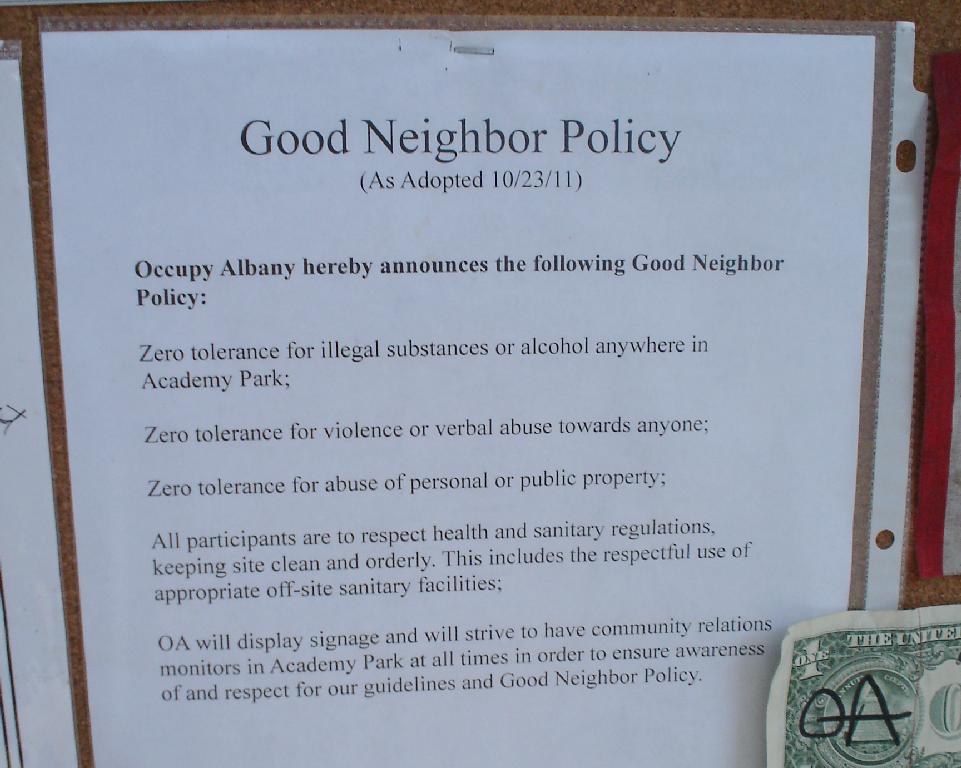
So where is occupy wall street? Unlike many protest movements, the message seems to be without leaders, and many participants have different thoughts as to what is wrong and what needs to change. Some groups seem to be trying to get along well with neighbors (Image from Blimix's Occupy Albany post) while others seem to think that their message is the way, the truth, and the light, and if they hurt innocent people, take services away from others, or damage property it's all in the name of good. (I'm looking at you Oakland protesters.)
The message that comes out most clearly from the mixed signals is There is income inequality in America. The protests seem to focus on the number 99%, implying that 99% of the people are the have-nots and 1% are the haves. They seem to think that 99% of people agree with their methods, their message, and their remedy. The remedy is not exactly clear, but seems to be taking money from the 1% and giving it to the other 99%. The other main message seems to be I am Angry!
Ok. So a spotlight has been shined on the fact that there is income inequality in America. Can we call the nature of the conversation changed, and talk about other remedies?
I ask, what about the world? The poorest NICU baby of a drug-addicted American mother is in the top 1% of the world population in terms of income services received, and food and shelter needs being met. Would the occupy folks take from that baby to help hundreds more in India, China, Africa, or South America? After all, that baby is in the top 1% world-wide.
I fundamentally don't buy the OWS remedy, or the selfishness of the remedy. I was taught not to envy and I don't think it's healthy. There will always be someone richer than you. The poor will always be with us. Instead of trying to tear others down, why not spend your efforts trying to build yourself and others up? If all those people spending all that time at the OWS-Oakland protests had spent it instead volunteering at Oakland's schools, or becoming partners with a child in the BigBrother's BigSisters program, would more good have been accomplished?
I can agree that the system is set up to favor those already in power. I fundamentally don't get the party divide on this issue however. There are so many regulations and tax incentives for this or that form of economic activity, many of which favor established players who can lobby to get their own form of activity protected, while hurting newcomers to those types of businesses.
I favor removing barriers to economic activity, removing special cases, removing government incentives to do something different from what makes the most sense, and I favor allowing more people to enter the ranks of the wealthy. There will always be a top 1%. That's how it's defined.
--Beth
There's lots of things that are bad in the world. Some things nearly everyone can agree on: "babies shouldn't starve to death." Some things that represent legitimate differences of opinion: "WalMart shouldn't open in this town." And some things that (to most people) represent illegitimate differences of opinion: "All jews should die."
There's some things we can't do much about and others we can change if only enough people felt the same way.
In the US, there's lots of ways that people raise awareness for issues they care about -- the Breast Cancer 3-day walk for example. There's numerous walks and hikes for much less well recognized diseases, which fund research and hopefully cures, as well as raise awareness and support for those who are suffering. There's walks for education, rallies for political causes, campaigns for people to call their elected representatives and let them know people care about a particular issue.
In the world, when the tides of change begin to turn, there's even cases where governments are overthrown and changed. The people establish a new way of relating to one another and a new way of doing things. Sometimes change is for the better, sometimes for the worse.
Sometimes, enough people banding together can make a change that used to seem like an illegitimate cause (civil rights) into a legitimate disagreement, which can change the nature of the conversation. The pendulum can even swing to the other side, and the campaign to remove civil rights from others is now considered illegitimate.
So where is occupy wall street? Unlike many protest movements, the message seems to be without leaders, and many participants have different thoughts as to what is wrong and what needs to change. Some groups seem to be trying to get along well with neighbors (Image from Blimix's Occupy Albany post) while others seem to think that their message is the way, the truth, and the light, and if they hurt innocent people, take services away from others, or damage property it's all in the name of good. (I'm looking at you Oakland protesters.)
The message that comes out most clearly from the mixed signals is There is income inequality in America. The protests seem to focus on the number 99%, implying that 99% of the people are the have-nots and 1% are the haves. They seem to think that 99% of people agree with their methods, their message, and their remedy. The remedy is not exactly clear, but seems to be taking money from the 1% and giving it to the other 99%. The other main message seems to be I am Angry!
Ok. So a spotlight has been shined on the fact that there is income inequality in America. Can we call the nature of the conversation changed, and talk about other remedies?
I ask, what about the world? The poorest NICU baby of a drug-addicted American mother is in the top 1% of the world population in terms of income services received, and food and shelter needs being met. Would the occupy folks take from that baby to help hundreds more in India, China, Africa, or South America? After all, that baby is in the top 1% world-wide.
I fundamentally don't buy the OWS remedy, or the selfishness of the remedy. I was taught not to envy and I don't think it's healthy. There will always be someone richer than you. The poor will always be with us. Instead of trying to tear others down, why not spend your efforts trying to build yourself and others up? If all those people spending all that time at the OWS-Oakland protests had spent it instead volunteering at Oakland's schools, or becoming partners with a child in the BigBrother's BigSisters program, would more good have been accomplished?
I can agree that the system is set up to favor those already in power. I fundamentally don't get the party divide on this issue however. There are so many regulations and tax incentives for this or that form of economic activity, many of which favor established players who can lobby to get their own form of activity protected, while hurting newcomers to those types of businesses.
I favor removing barriers to economic activity, removing special cases, removing government incentives to do something different from what makes the most sense, and I favor allowing more people to enter the ranks of the wealthy. There will always be a top 1%. That's how it's defined.
--Beth


![[identity profile]](https://www.dreamwidth.org/img/silk/identity/openid.png)
no subject
Date: 2012-01-31 11:25 pm (UTC)The general strike was HUGE. There were thousands of people walking from downtown Oakland to the port. I stood at the foot of the bridge for a long time and watched people pour over it. They filled the bridge and they just kept coming. I don't know how big the crowd was, but I can tell you that I have never seen a bigger one. Ever.
It's not that we object to the existence of the top 1%. That's totally not the point. It's that the difference between the top 1% (and it's more accurately the top 0.1% or even the top 0.01%, but "one percent" is a lot easier to say) and the rest of us is so very, very large. It's not right for it to be so extremely stratified, not when people are going without health care and education and other necessities.
For solutions, I suggest taking a look at www.wedontmakedemands.org.
no subject
Date: 2012-02-01 12:00 am (UTC)Since there's no unified set of demands, no communications department for the movement, I get the impression that some assorted random people on the street (without backgrounds in economics) think the solution revolves around wealth redistribution, but that certainly isn't what the movement as a whole is about.
If I had to give a summary of my impression of OWS's grievances, I'd say something like "Government needs to be equally accessible to, and accountable to, all citizens."
But again, this is just my impression, and I haven't even been to any of the protests.
When you say that you fundamentally don't buy the OWS remedy, what do you hear that remedy being? Radical wealth redistribution? (If so, I agree that isn't the solution, but as I said, I don't think that's what OWS is about.)
Everything I've been able to gather from the news seems to confirm
no subject
Date: 2012-02-01 03:18 pm (UTC)I can't address the rest of your comment before first touching on your question "what about the world?" I've only recently started to understand the term, but it feels to me like a classic example of "derailing" the primary conversation. OWS is fundamentally a reaction to aspects of current American (or Western) society: it makes no claim to be the single most crucial issue facing humanity today. (If you are truly determined to only worry about the very most useful contributions you can make to humanity, every single dollar that you donate to charity should be for mosquito nets to fight malaria. I would be surprised if you've made that choice.) But sometimes people feel more motivated to take action on issues closer to home, and I don't think we can blame them for that.
From what you've written here and what I've read about OWS, it feels to me like you've missed the point of the whole "99%" issue. As you point out, it wouldn't even make sense to object to the existence of an upper 1%: inequality in wealth is inevitable (and probably desirable), whether due to birth or luck or hard work. The issue that I have seen raised again and again by OWS is that the size of the gap between the very rich and even the merely well-off is enormously larger today than it was when you and I were born. One of the clearest illustrations that I've seen of this is this graph of CBO data. When I read it, I see a nation that has enjoyed a tremendous gain in productivity whose benefits have been minimal for the vast majority of the population. (Another relevant visualization is the ratio of average CEO pay to average worker pay, which shows much the same trend.)
I really don't think that this is about "envy", and I'll admit that I sometimes resent the suggestion that it is. Most of what I've heard from OWS is a demand for a fair system, not a demand for equal outcomes. Somehow, our political/economic system has shifted since the 70's to favor greater inequality. I don't call it envy to say "let's all get richer together" or to complain when the yield of our collective effort goes primarily to a few.
And I (at least) haven't heard OWS shouting for any specific "remedy" (selfish or otherwise). I think that most of them recognize that they aren't professional economists or legislators and that they don't know how to fix the system to restore that fairness (I don't either). Yes, it's inevitable that one result of any such fix would be that the people currently in that top 1% (or 0.1% or whatever) would not be as much richer than everyone else as they are today. But on some level, I see their current relative wealth as a symptom of an underlying systemic problem, and the eventual drop in that relative wealth as a side effect of the cure, not as its purpose. Again, it's hard for me to describe that as "envy".
More broadly, I would say that if the OWS protests do somehow manage to help the nation to recognize and fix these underlying issues, I think that the resulting improvement in quality of life for the poor (and in economic mobility for everyone) would provide a more meaningful and lasting benefit for underprivileged kids than a few more school volunteers would. Not to devalue the activities that you mentioned! But they are by their nature largely trying to fix symptoms of the same underlying inequality that OWS is talking about: as long as the system is set up to funnel society's gains mostly to the handful of best-connected among us, the broad patterns aren't likely to change.
no subject
Date: 2012-02-01 03:19 pm (UTC)But when the housing market inevitably crashed, the homeowners got stuck with mountains of debt, the nation's taxpayers forked over vast sums in bailouts, and the bankers largely walked away not just with all the money they'd made over the previous few years but with big bonuses to boot. I honestly don't know what we could have done differently in the end to avoid a global banking collapse, but it's hard to see any argument that the system as a whole worked out in a fair way. And once again, I absolutely do not call that complaint "envy".
no subject
Date: 2012-02-01 04:15 pm (UTC)I don't mind people being richer than me. The Occupy Boston protest chaplain in my house doesn't mind people being richer than him (or he wouldn't be applying to seminary, or spending business hours volunteering with homeless teens in foster care, and in a pediatric oncology ward).
What I mind is that the rich people have managed to lobby the government into allowing them to pay less taxes (as a percentage of income) than working families with no investments pay. What I mind is that I see more and more barriers to entry into the ranks of the wealthy (like the revisions in the rules for the SATs that allow students to re-take the exam infinite times and submit only their best scores for each section, and like unpaid "resume building" internships). What I mind is that my broke-ass, trades rent for babysitting, nanny appears to be the person, locally, most concerned with the fate of homeless teens in foster care - people who are neither charming nor photogenic, and in the current system, will never be able to afford to become even moderately well-off or even slightly influential.
I do not see that the Occupy movement has proposed a remedy. I do see, however, that they have instigated a conversation that acknowledges that there is a problem. Many, many people before them have attempted to instigate that conversation. Warren Buffet, in particular, has been trying. Those attempts failed.
Occupy managed to get the conversation started. That was good work.
Why choose Oakland?
Date: 2012-02-01 05:24 pm (UTC)I ask because my impression is that Oakland has trouble paying for basic city services in the best of times, and that protecting private property and law and order (which is a major function of the police) is hugely expensive in times like this. Choosing Oakland as a center of protest would seem to hurt those whom the movement would most like to help.
--Beth
Re: Why choose Oakland?
Date: 2012-02-01 05:25 pm (UTC)no subject
Date: 2012-02-01 05:49 pm (UTC)Why is the movement named Occupy Wall Street and not Occupy Washington? The recent stuff in Oakland has really turned me against the protestors who continue to act, and who hurt Oakland and everyday folks. There was a quote on the radio that seems to sum up how the protesters look to the outside world. It went something like, "It was the police's fault that there was violence because they wouldn't let us take over that building."
It was that quote that made me go, "Huh??" Your freedom stops where my nose begins. How can you possibly think that it's ok to take over private property? Ditto for closing the ports.
The government made a profit on the bailout money paid to private banks. It's Fanny & Freddy (government institutions) that are still bleeding cash like no tomorrow, and the Auto Workers Union that won big payouts from the government. The government set up the system which encouraged the banks to make such crazy loans in the first place. I'm fundamentally against the government trying to encourage or discourage specific forms of economic activity, such as buying a house. It should only step in when there are crystal clear negative externalities (frequently environmental) and then only with the lightest hand possible.
On the other topic, I've raised $1000 for mosquito nets in the past year, going to an organization that not only just hands them out, but actually teaches people to use them and $2500 for secondary education for poor students in Africa, in addition to my own personal giving. I think the whole world is important.
--Beth
Re: Why choose Oakland?
Date: 2012-02-01 05:53 pm (UTC)--Beth
Re: Why choose Oakland?
Date: 2012-02-01 06:07 pm (UTC)Oakland's city government has made terrible choices about Occupy, and you are right that they are overspending. On the night Scott Olsen was badly hurt, there were police from at least seven other jurisdictions (Berkeley, Walnut Creek, Alameda County Sheriffs, et cetera)- which Oakland had to pay for. It was incredibly expensive, stupid, and unnecessary.
This video shows police in riot gear - which is expensive and aggressive - and, about 30 seconds in, it shows them tossing a tear gas canister directly into the middle of a small group of people who were trying to help an injured man. The group was not rushing the police or rioting or doing anything that would remotely warrant that kind of brutality. OPD originally claimed that no such weapons were used, that the smoke and bangs were all from weapons thrown by the protestors, but they backed down on that claim when video evidence of their wrongdoing came to light.
no subject
Date: 2012-02-01 06:13 pm (UTC)FYI, in Oakland, it really has been the police who have started the violence, not the protestors. In other places, too - I'm sure you have heard about the violence instigated by the police at UC Davis, for instance. I'm talking about the policeman who sprayed mace directly into the faces of students who were doing nothing but sitting quietly. Also, I recommend that you don't look for what happened at UC Berkeley, because the video is really upsetting.
Fanny and Freddy are only quasi-governmental institutions, which is the problem. They are sort of a hybrid of government and private sector. If they were all one or the other, they might actually have some accountability.
Re: Why choose Oakland?
Date: 2012-02-01 06:25 pm (UTC)Now that the conversation is changed and people are talking about it and how to change how government is done, what does continuing to protest and be out on the streets (as opposed to walking door-to-door collecting campaign contributions, encouraging people to call their representatives, or other activities which do not risk confrontation with police) hope to accomplish?
As others have noted, I do not understand the movement but hope to learn more.
--Beth
no subject
Date: 2012-02-01 07:53 pm (UTC)I don't only "sometimes" resent being told that being against a massive disparity in income and wealth is "the politics of envy." No, I resent that 100% of the time. It's not envy to want a roof over your head that has walls and windows and electricity and clean running water. It's not envy to want to be able to feed yourself nutritious food, to feed your kids nutritious food. It's not envy to want to put clothes on your own or your children's backs. It's not envy to want to live in a neighborhood where it's safe to go outside after dark.
It's absolutely disgusting that the right wing talking point states that wanting to earn a wage which allows a person to do all these things is "envy."
no subject
Date: 2012-02-01 08:58 pm (UTC)The government set up the system which encouraged the banks to make such crazy loans in the first place.
This illusory separation of what the government does from what the banks do illustrates one of the fundamental problems that OWS is trying to highlight. Wall Street *authored* the bill that deregulated Wall Street, thus allowing the crazy loans. They already owned Congress, so all they had to do was write a bill and say "pass this".
The problem isn't that the government is handling the banks badly. The problem is that the banks own the government, and have maneuvered themselves into a position of such little accountability and responsibility that they can easily cause another Great Depression.
This isn't just an issue for poor people. Depressions hurt rich people too! But you don't take to the streets to protest the fact that, due to corrupt politics, you have to buy a $40,000 sports car instead of an $80,000 sports car. So it's mostly the poor people taking to the streets to protest the fact that, due to corporate lobbying of fat cat politicians, they cannot afford to feed their kids.
That's not envy. It's not resentment of the money that rich people have. It's resentment of getting their whole lives screwed over by ultra-rich people who make out like bandits by destroying the economy.
Re: Why choose Oakland?
Date: 2012-02-01 09:23 pm (UTC)The conversation is only the start. If we are to effect real systemic change, we can't just abandon things as soon as people notice that something's wrong.
There is a "why choose" element to your question. Lots of people are both Occupying and calling our reps (I called the Oakland sups, the mayor, the governor, both congresswomen). You can be a protestor and an activist and a voter.
no subject
Date: 2012-02-02 12:22 am (UTC)I voted in the Oakland election a few years back to levy a tax to fit up the Kaiser Center seismically and make it into a new Main library to replace the ancient overcrowded broken library we have now. That ballot measure got 64%, not the 66% necessary. The Kaiser Center continues to rot. Every once in awhile the city talks about selling it for a momentary cash infusion, but their suggested profits are always insanely high (http://www.abetteroakland.com/no-budget-for-oakland/2011-05-01).
I've lived in Oakland for a decade now and watched the news and local blogs, and I'm an everday person who thinks that Occupy is doing more good than harm, and the Oakland administration is doing a horrible job running the police in this instance.
For the other point of fact, it is bank propaganda that the government made money on the TARP bailout. http://www.nakedcapitalism.com/2011/11/quelle-surprise-banks-lied-about-bailout-funds-and-got-13-billion-in-profit-from-them.html
One note of Occupy points that hasn't yet been raised, that is of major importance to me: where are the jailed bank CEOs?
Corruption is, I think, the essential problem right now. Others here have mentioned the cozy Wall Street/Washington relationship, but I'd like to drive home the point: in the past, the US dollar was a safe haven because we had a better system of laws than any other country. The bubble of the 2000s proved that is gone. It is completely legit for an accounting firm to say "sure, the bank paid us for rating their security AAA without looking at it. You got a problem, bub?"
Other countries know our economy is built on lies. Our rich people know our economy is built on lies. So why invest?
Thus we have everybody holding their money and not using it. Thus interest rates are 0.79% on my savings account. Thus I'm not building up the cash I need to compound to retire on.
no subject
Date: 2012-02-02 01:05 am (UTC)no subject
Date: 2012-02-02 03:18 am (UTC)Accounting firms != ratings agencies.
There are problems with both sets of organizations, but the problem you're describing is with ratings agencies.
no subject
Date: 2012-02-02 05:15 am (UTC)--Beth
Occupy
Date: 2012-02-02 06:16 am (UTC)